
PRESSURE DOESN’T DEFINE LEADERSHIP. IT EXPOSES IT.
In conversation with former Google Marketing and Sales Leader Angeliki Galanopoulou on the Adaptive Times podcast
I examine how credible communication, consistent behaviour and safe challenge affect whether issues surface early, decisions are acted on and change delivers the value expected.
That was the thread running through my conversation on the Adaptive Times podcast with Angeliki. We spoke about trust, culture, adaptability, and what leadership really looks like when pressure rises. Not the theory, but the reality of how people experience leadership day to day.
A moment that shaped how I see trust
Basra 2004. Seven of us were in a tent waiting for lunch. Mealtimes were one of the few parts of the day that felt normal. Suddenly, a whistle and thud, tent shakes. We continue chatting, the dull tones of explosions became normality for us. Then a second impact, closer this time. Radios burst with calls to take hard cover. Everyone scrambles.
I grab my kit, and don’t ask me why, but pick up a delicious looking doughnut I’d been eyeing up!
Running across the compound, incoming mortars continue. I fall flat on my chest, my arm miraculously suspended in the air, doughnut still intact.
My comrade was ahead of me. He had a choice in that moment – keep running or come back. He turned around, pulled me up by the scruff of my neck and we ran together to safety and the ISO container. He probably saved my life.
When we reached cover, there was that mix of adrenaline and silence, until someone shouted, “Jamesy… got the doughnut.” Laughter followed. I broke it into pieces and we shared it (although dusty yet still tasty!). For a moment, everything felt normal, human, and connected.
Not the explosion. The choice.
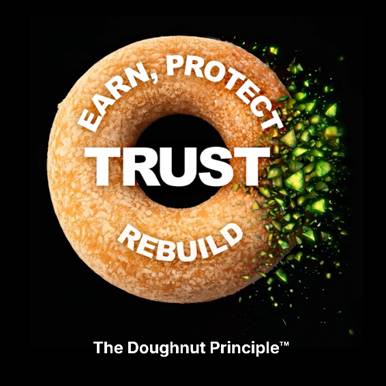
The Doughnut Principle™ – how trust really works
That moment shaped how I think about trust.
Trust is not something you say. It is something you do. And it operates as a continuous loop.
- Earn: Trust is built through consistent behaviour, not intention or title
- Protect: Trust is maintained through reliability, clarity, and how you show up under pressure
- Rebuild: Trust will break, and when it does, it requires ownership, action, and visible change
This loop never stops. Leaders are always moving through it.
Culture is behaviour, not words
We often talk about culture as something that can be defined through values, messaging, or internal campaigns. In reality, that is not what people follow.
People watch behaviour.
They notice what happens when something is not quite right:
- Someone stays silent (the bystander effect)
- A leader does not address the unsaid or difficult conversations.
- A hard announcement on a town hall – scripted to precision and you don’t see them again.
That is where culture is set.
Behaviour compounds over time:
- One person hesitates, others follow
- One leader avoids a difficult moment; the room learns what is acceptable
Over time, that becomes the culture. Not the words, but the behaviour.
Leadership is exposed under pressure
People do not really care what you say. They are watching what you do when things become difficult.
That is when leadership is judged.
“If people do not feel safe or seen around you, you are not leading. You are simply in charge.”
Leadership shows up when things do not make sense. When your team is asking questions, you cannot fully answer.
In those moments, you have a choice:
- Pass the message on or manage upwards and ask the questions your team cannot ask
Because when leaders can’t answer or don’t have the answers, “we are where we are” becomes the fallback instead of asking the questions themselves. And once that sets in, trust starts to erode.
Empathy is not the end point
Empathy matters. Listening and allowing someone to feel heard can change how they leave a conversation.
But empathy is not the full picture.
Empathy is a state. Compassion is a choice.
- Do you adjust the workload, step in or speak up?
People remember what you do next.
Adapting without losing yourself
There is often an expectation to bring your whole self to work. The reality is more nuanced.
People adapt depending on the environment, the pressure, and the situation.
The key difference is between:
- Adapting: adjusting your style while staying grounded in your values
- Performing: saying what is expected and diluting your judgement
When leaders stay grounded, they can adapt without losing themselves.
What this looks like in practice
During the pandemic, when Brian Chesky had to make the decision to lose a third of his business at Airbnb, he did not hide behind formal statements.
He stayed visible.
- He explained the decisions
- Showed up consistently throughout the public scrutiny
- Asked his LinkedIn network to support those leaving
The outcome did not change, but trust held because people could see how he was leading through a very difficult situation.
The shift in leadership now
Leadership is no longer judged later. It is judged in real time.
It is shaped by:
- Small decisions
- Everyday behaviour
- Moments of uncertainty
These are the moments people remember. And they are the moments that define leadership.
Key takeaways
- Trust is built through behaviour, not intention
- Culture is shaped by what is tolerated, not what is written
- Leadership is visible under pressure, not in stable conditions
- Empathy creates connection, but action builds trust
- Adapting is necessary, and values must remain constant
The choice every leader has
My comrade had a choice that day.
Leaders have the same choice every day.
Not in large, staged moments, but in small ones:
- The moment you speak up, stay silent or step in
These are the moments people notice, replicate, and remember.
Listen to the full conversation
If you’d like to go deeper into the conversation, listen to the full episode here: